Saturday, February 19, 2011

MIND MAPPING ASSIGNMENT INSTRUCTIONS MWF CLASS

A mind-map is a whole-brain method for generating and organizing ideas which is largely inspired by Leonardo da Vinci's approach to note-taking. The concept was brought into the mainstream by Tony Buzan and is based on patterns found in nature and research on how humans think and how the brain works. Mind-maps engage both the right and left hemispheres of the brain, which makes them ideal for stimulating imagination and creativity. Even though mind maps are powerful creativity technique, they're very easy to make.

Mind-maps can be used for the following:
- Personal goal setting
- Problem solving
- Writing a business plan
- Generating ideas
- Improving reading comprehension and retention
- Studying for exams

General Laws of Mind Mapping

1. Get a plain sheet of paper and turn it so that it's on its landscape side. You're also going to need colored pens or pencils.

2. Mind maps represents a task or idea in pictorial form with a minimum of words. They rely on key pictures and key words that act as triggers. In the center of the page, draw a picture or image that represents the central concept of your mind-map.

3. Use colors throughout. Adding images and colors stimulates right-brain thinking; that is, it stimulates creativity and imagination.

4. Write down a key word which represents the central idea. Throughout the mind map you'll use just one key word per line. Keywords exercise your analytical "left brain" and help you find the essence of your subject. Using just one key word per line gives you the freedom to discover the maximum amount of creative associations for your key word. When you first start mind mapping, the temptation to use complete phrases will be enormous, but you should always look for opportunities to shorten phrases to a single word.

5. What are the main concepts or ideas that can be derived from the image and key word you've placed in the middle of the page? Draw anywhere from five to nine thick branches leading out from your central image/keyword. Each of these branches represents a Basic Ordering Idea (BOI), and you're going to find an image and a key word for each.

6. Look at your main branches- your BOIs- and begin making free associations. Draw smaller sub-branches that stem from each BOI to accommodate the new associations you're making. Then connect third-level branches from the ends of the sub-branches, and so on. Let your mind work freely by association and have fun.

7. Make the branches curve and flow.

8. Use images throughout. The images make the mind-map more interesting and more memorable.

Examples of mind-maps:


MWF class:
Your assignment is to create a mind-map on "DESIGN THINKING" based on your readings from Roger Martin's book The Design of Business. The mind-map should communicate ways one can develop an aptitude of design thinking. Use the "General Laws of Mind Mapping" to help you get started. ASSIGNMENT DUE MARCH 4TH in CLASS.

Friday, February 18, 2011

The Vocal People - Synergy/Symphony


So this video is really quite incredible. One of my favorite topics has been team work, how the final product is greater than the sum of the parts. Covey calls it SYNERGY and Pink calls it SYMPHONY. This video definitely demonstrates in an odd way how creativity, design, play, understanding, and many other principles discussed by Covey and Pink can come together to create something truly amazing. It reminds me a lot too of the Fry Street Quartet, how they move together and use a lot of nonverbal communication. It's just a great example of teamwork. I love they idea of synergy, or symphony, and believe that it truly is the best way to arrive at the best conclusions and answers to any problem. I'd love to hear anyone's comments on the video.
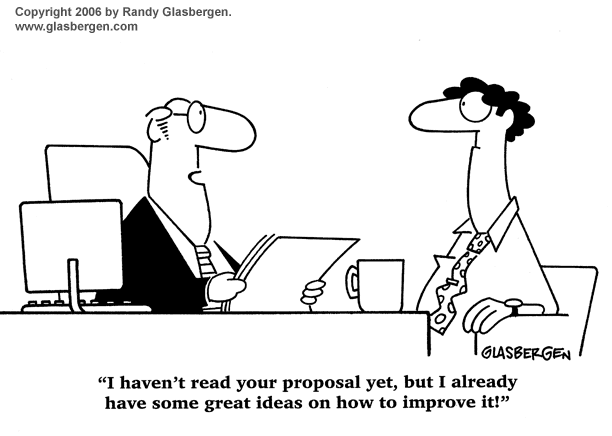
To me this cartoon depicts the concept of seek first to understand, then to be understood. Often times I find myself not even listening or really understanding what the other person is trying to say. People in general tend to start thinking immediately how to help improve the others situation and give advice on how to deal with the issue at hand. Last night I talked on the phone for about four hours, yes that is an extremely long time but it wasn’t only one person I was talking too. I wanted to tell my story of what had gone on during the day because it was rough and as I began to confide in my friend; he started giving me advice on how to go about dealing with the situation. All I wanted was for him to listen while I talked through my day, since that wasn’t happening, I decided to ask how his day was and he proceeded to tell me about his day. I listened intently and let him talk. To my surprise I learned and heard of situations he’d been in that would have never crossed my mind. People like to tell their stories and that is how we relate to others. I have found that if I allow those around me to tell their stories, I actually have more in common and can better relate to those I care about. It amazes me how much people will disclose to you if you are interested and try to empathize with that person.

Michaela Ferguson

Wednesday, February 16, 2011

PLANNER PROTOTYPING


I'm sorry not everyone was able to present in class today. We'll take time on Friday for groups who were not able to present. Here are the photos :)

Motivations

In our group meeting today we got talking about motivation and leadership. It reminded me of this video that one of my teachers last semester showed to us. Turns out it was based on a lecture by Daniel Pink.


Tuesday, February 15, 2011

Unique Design and Innovation

In A Whole New Mind, under the design section it discusses how the market has remolded itself over the years. Things have changed-- now to enter the competitive market you must have a base line of a reasonable quality and price but, in order to stay, there are many more requirements: beauty, meaning and a level of art in whatever you make, or rather, design. I thought this comic illustrated that principle. When companies start to put out products that are all competitively equal, no company sticks out unless they are thinking outside of the current market and taking the initiative to find what changes the consumer wants and would expect from a new product design. In essence, they have to work to create something others haven't thought of, and use their talent to recognize how to design a product to fulfill someone's needs-- even ones the consumer never knew they had.

The Art of Innovation: Group 2

The Art of Innovation is about IDEO and their keys to their successful business. One key point made in the book is designing for the consumer. Instead of trying to change the consumer's habit, they believe that "the best products embrace people's differences" and "celebrate human behavior." Are there any companies that you believe exhibit this same ideal, or any specific products that "celebrate human behavior" instead of attempting to modify it?